Hey, what’s up. I’m Riley, and I’m working to make climate change a more verifiable problem. LLMs got really good at math and code in part because those problems have verifiable answers. We can currently only check on the planet coarsely, and the world's little details matter to me.
Ecology and environmental science are full of beautiful, local accounts of something interesting happening in nature, but those explanations don’t always add up into data or predictions you can keep verifying against.
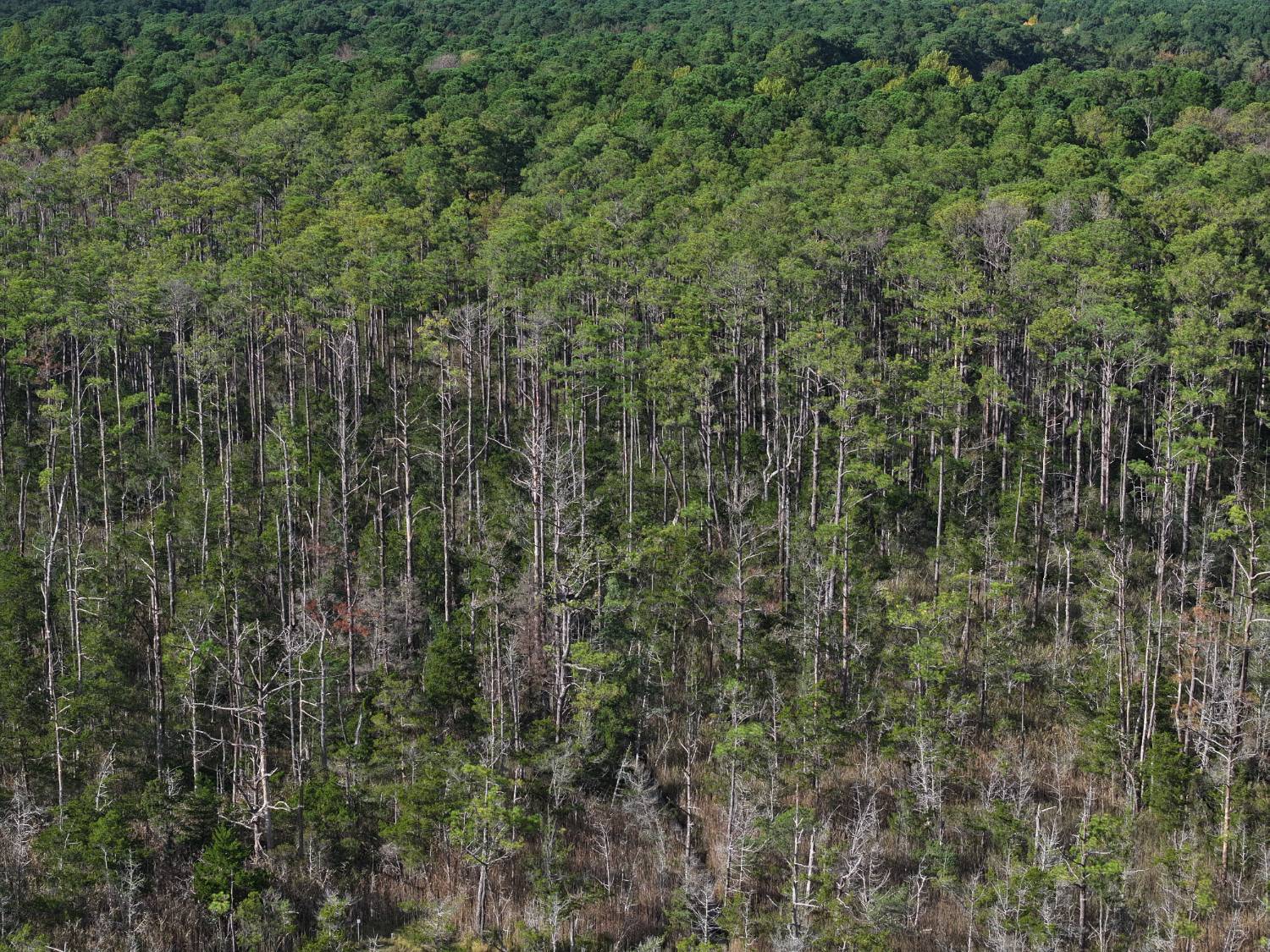
Earth is complicated. How can we know what’s going on, in detail? Now that we’ve seen language models learn to represent a very complex system by scaling bigger, I’m optimistic that the same recipe can work for ecology. Remote sensing technology like satellites and lidar will help, but I think we’ll be bottlenecked by field data, which remains extremely hard-earned. I have a strange tick-borne illness to show for it.
Resolving this bottleneck is urgent: ecosystems are slow, and AI improves fast. There is likely going to be a period of overhang where a future aligned AI will be capable of acting to make the earth more resilient, but without enough information to know what to do. We can’t go back and measure 2026 later. The sooner we scale field measurement, the shorter that overhang will last. I want to build systems that can deliver an internet’s worth of data about the planet.
We can eliminate the field data bottleneck with more measurement, better measurement, and better standardization across how we measure. I work on forests: they’re most of the terrestrial carbon sink, their reactions to change make them a tricky moving target for prediction, and I like studying them.
For the last few years of my PhD I’ve mostly been a hydraulics guy. I have some exciting new hardware and theory that I’m stoked to debut next month at AGU regarding sap flux sensors, my field’s way to measure the rate that water flows through trees. With these new sensors, we can take precise measurements frequently and autonomously, for dirt cheap. So far, this is my fastest horse for accelerating field measurement, by a lot.
But hydraulics are only half of a plant’s core arbitrage. They sell water to buy carbon, and the balance between these two processes in an uncertain world determines which trees survive and for how long. This summer, in a quest to understand the other side of the market, I took a foray into the world of measuring photosynthesis.
On Photosynthesis
I’ve inherited most of my ideas about photosynthesis (and plant ecophysiology in general) from Graham Farquhar and John Sperry. Every grad student has a handful of old guys they exalt. Those are my guys! In their world, photosynthesis has two layers:
1.) A machine, made out of biochemistry and represented in math. If you can measure the plant well enough to parameterize the machine, you can map the conditions a leaf faces to how much it could photosynthesize.
2.) A decision-maker, emergent from complex, diverse biology. Stomata open and close to turn photosynthesis on and off, but we can’t build them out of molecules or enzymes the same way we can for the machine-like layer, at least yet. We represent them as behavior: plants like gaining carbon, they dislike losing water, and they act accordingly.
The holy grail of measurement, then, is to be able to fully separate those two layers. If you measure a leaf and see that it isn’t photosynthesizing much, is it the capability or the willingness?
This was the situation we found ourselves in this summer. By we, I mean me and Acadia Conboy, an undergraduate researcher visiting from James Madison University, who worked hard to help me with this project all summer.
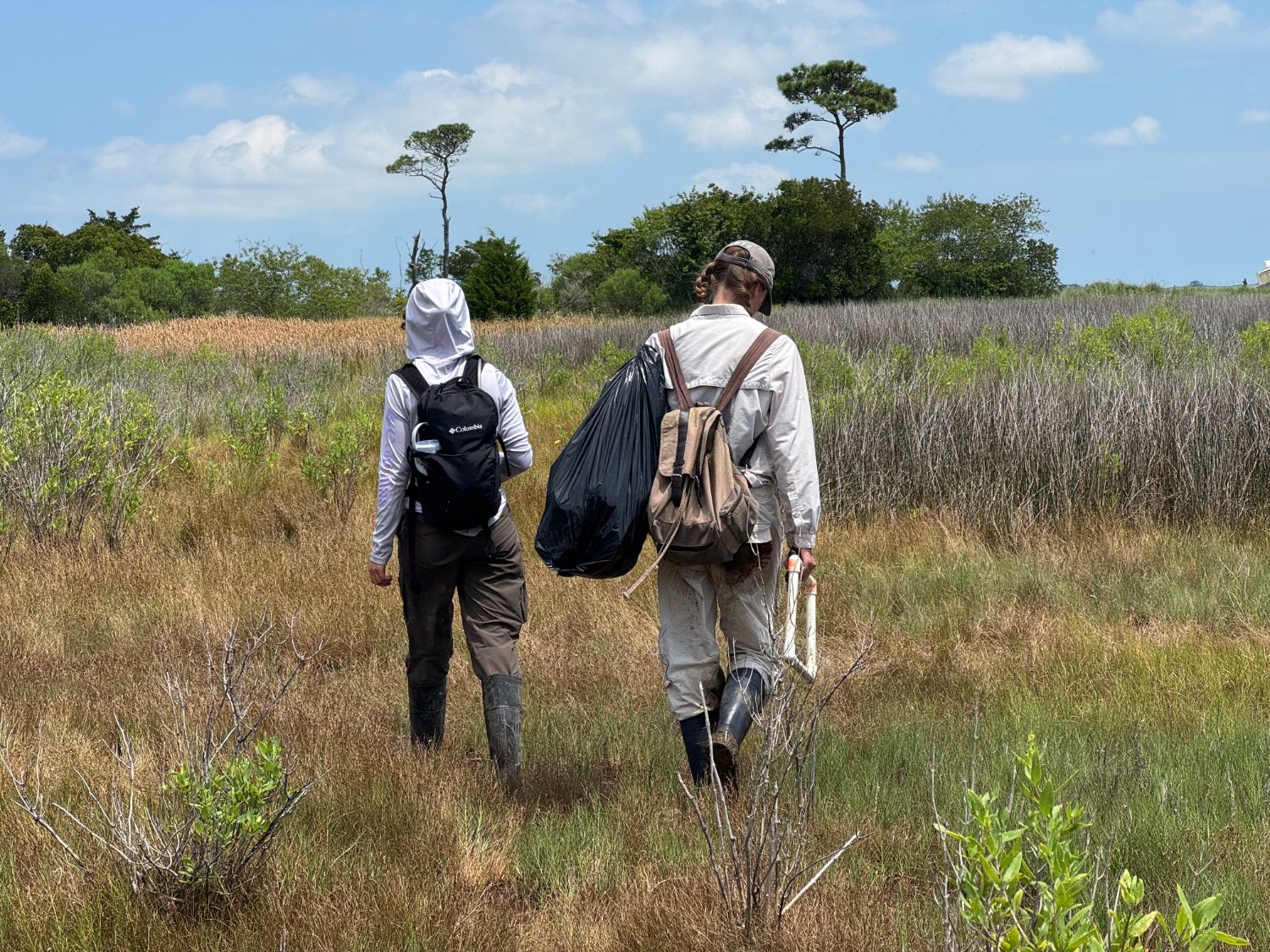
At our field station (near Cheriton, VA) and site (the Brownsville Preserve) we examined leaf after leaf after leaf, and we weren’t seeing much action. Stomata were very closed, and photosynthesis was very low.
Nominally, our methods are already robust to this. Our field's main tactic for parameterizing the machine, called the A/Ci curve, follows photosynthesis as you vary the leaf's internal CO2 concentration. Even if the stomatal doors are only barely cracked open, by cranking up the CO2 outside the leaf, you should be able to see how photosynthesis responds across a wide enough range to fit the model.
This can break down in practice. The preeminent device for measuring photosynthesis, a ghostbusters-gun-like thing called the LI-6800, can’t actually see how much CO2 is inside the leaf. It has to infer this from how much water it sees exiting the leaf. There are a few common failure modes, for example:
- Leaves also lose water through their cuticle but don’t gain CO2 through it. When stomata are mostly closed, this throws off the stomatal water estimate, which throws off the internal CO2 estimate.
- CO2 inside the leaf has to make it to the cells, and the length of this trip varies across leaves.
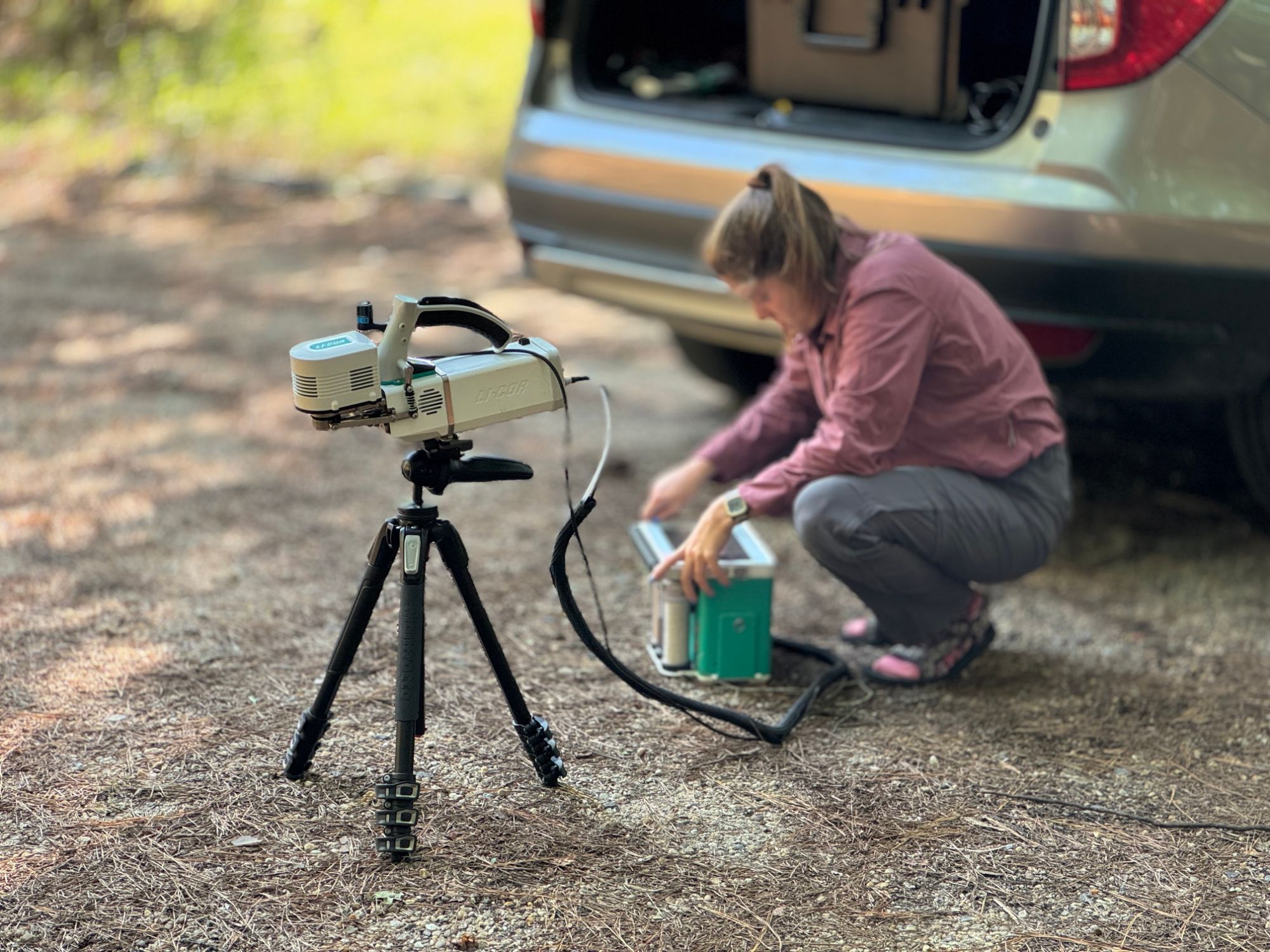
The net result of all of this is that a naive approach to measurement can confound machine and behavior. Not good. This work would be easier and better if we could just get the stomata to open up while we measure.
I Made A Mistake
Earlier this summer, I thought I had figured it out. We started by unsuccessfully dabbling in what we called luxury conditions: cool and humid, with moderate light and CO2. The plants didn’t care and stayed shut. But when we took away most of the CO2, we saw the stomata open up, and close again when we brought it back. Of course! We could just take away their food long enough to make them hungry. That felt plain, obvious, and wasn't something that we had seen in the documentation. Seemed like a big opportunity.
This worked on two leaves in one-off trials, so we quickly packaged this new starvation step into an automated program, spent a week kicking it around to work out some kinks with the LI-6800, and started collecting a more standardized dataset. To my delight, almost every single leaf showed a brief blip upwards in gas exchange following its starvation step. I loved the blips.
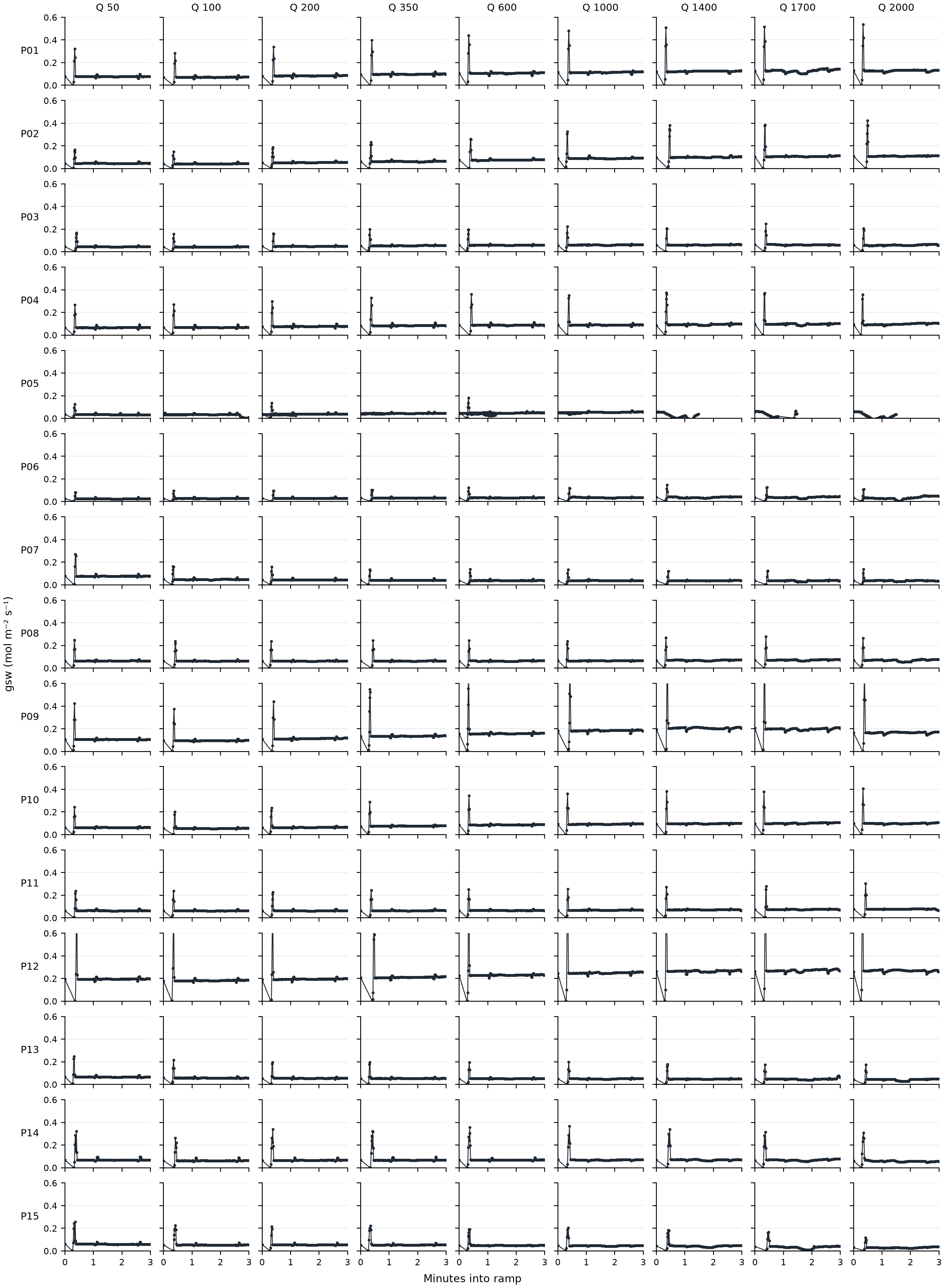
The blips were not real. Every time the LI-6800 comes out of a starvation step, its humidity reference wobbles and overcorrects briefly. It’s super obvious if you look at all the raw data behind all of the blips at once: plant biology doesn’t run on exact clocks like these:
Occasionally being wrong is a good sign. If you’re never wrong, you’re probably not getting outside of your comfort zone enough. I've made far dumber mistakes than this as a researcher.
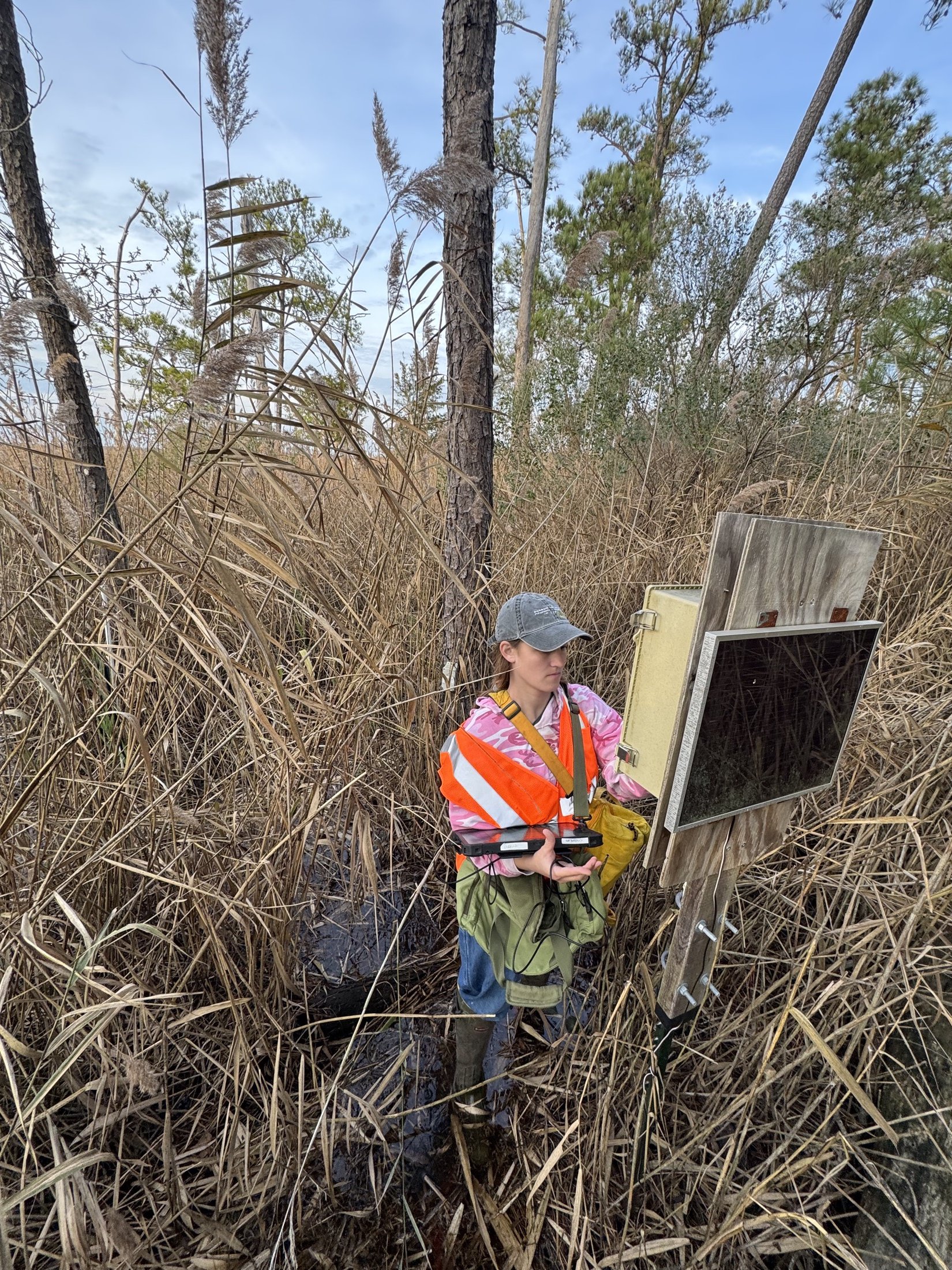
But I don't feel great about unknowingly passing along something blatantly incorrect in a research proposal and in my department's poster session. This gotcha wasn't very stealthy or hard to disentangle once I saw the raw data, but I literally had not touched the raw data. Check out my sweet setup from my field station visits this summer:
- The LI-6800 ran to my laptop on an ethernet cable.
- An LLM agent watched for new files and pulled them down.
- The agent would make a bunch of little figures and tables for me.
- I would gleefully inspect beautiful (and apparently, smoothed over time) figures in a little HTML window.
I suspect I'm not alone in this: many of us are done writing code.
The smoothed figures hid the jaggedness of the blip, which was the giveaway I would've needed to catch it early. We were working with Phragmites australis, which is a type of grass that lives in our forest understory. Grass and understory are both strong indicators for faster stomatal responses. Smoothed, the blips looked a bit fast but not unbelievable. Raw, the blips were clearly too fast to be real.
So I think this artifact easily getting past me has relatively little to do with the LI-6800 and a lot to do with how I work with LLMs. If I did this project in the first year of my PhD, pre-LLM, I would've been way more likely to catch a bug like this. It used to be mandatory to spend an hour or two clunking around in Python to look at all the column names, data types, and maybe plot some random stuff to see what's going on.
At no point was it going to occur to me to ask the agent:
"Yeah, looks great, but hey, is the machine doing anything crazy with its humidity reference right now by any chance?"
But I (probably?) would've found it incidentally amidst the clunking. That world was cute and knowable and maybe a bit sturdier, but I'm not going back to it. That's not to say that we should just accept being wrong more often or that it's okay to propagate something incorrect into your research products. Rather, this is a very clear signal that it's time for me to make structural changes elsewhere in my research workflows to protect against the new failure modes.
I'll be thinking about this. For now, I think the main way to reap the benefits of LLM-forward research while mitigating the drawbacks is to release smaller results, more often, and more openly. If we're producing more stuff and each chunk is less trustworthy, it gets easier to run with something incorrect (as I've done here). More frequent syncs help catch things early.
New Dataset and Protocol Just Dropped
Let's start here! Here's my photosynthesis project. You can find everything below.
I'm not sure how promising reduced CO2 looks as an avenue for opening stomata from here: it did work on those two Morella leaves, but that's not a lot of evidence.
In the process of testing it, though, we managed to produce (what we believe to be) the world's densest publicly available record of photosynthetic measurements per leaf. We measured photosynthetic rates across a surface of light and carbon dioxide concentrations. This kind of data is vanishingly rare: only 2.1% of the nearly 2700 LI-6800 papers I checked provided their raw data. And I could only find three cases of researchers providing full 3D surfaces as we've done here, all much smaller gas-exchange datasets than ours.
I think the thing I'm most excited about in this line of research is that the line between mechanism and behavior seems to be blurrier in photosynthesis than it is in hydraulics. Hydraulics is physics, and physics has shorter description lengths than chemistry. It's murky as to where you'd account for something like stateful light induction, a tidbit that we found in one of our many one-off tests (all published alongside the big dataset).
For years, I've had this idle daydream of a generalized plant model where we keep the physical/chemical rules and ditch the handcrafted approximations of behavior, replacing them with a policy learned directly from data. If the machine is blurry, maybe that's a sign I should ditch all of the attempts at rules and just go fully neural. I would love to have enough data to actually run the scaling experiment.
But I gotta verify my own work before I can verify the whole earth, I suppose.
Comments
Loading comments...